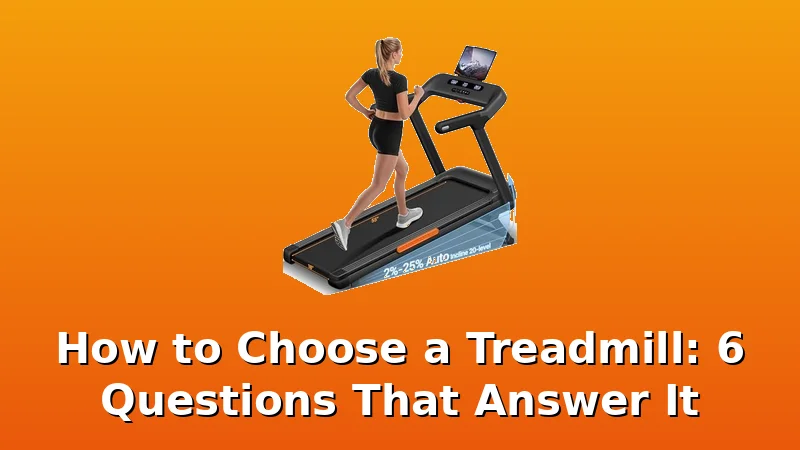
I've been testing treadmills in my 680-square-foot Austin apartment for years now, and the question I get most from runners and walkers alike is simple: how do I actually pick one? Not which one is "best," but how to look at a spec sheet and know if it's lying to you.
Related: How to Lubricate a Treadmill: The Thoughtful Addition That Saves the Belt
I've folded, wheeled, and run on over 30 machines in that same living room, and I've narrowed the whole process down to six questions.
Answer these honestly, and the right treadmill basically picks itself.

CURSOR FITNESS 16% Incline Treadmills for Home,400 LBS Portable Walking Pad |...
Real motorized incline, compact deck, quiet motor for the price
Belt is narrow; not for runners with long strides

CURSOR Fitness Treadmill with 20% Incline, Treadmills for Home 400 lb |...
Higher weight capacity, stronger motor, more incline range
Heavier to move; takes up more floor space

ProForm Carbon TLS | Foldable Treadmill for Running and Cardio Workouts with...
Feels like a gym machine, iFit integration, sturdy frame
Price is 3x the budget picks; overkill for walkers
Prices and availability were captured from Amazon Creators API and may change.
Pros
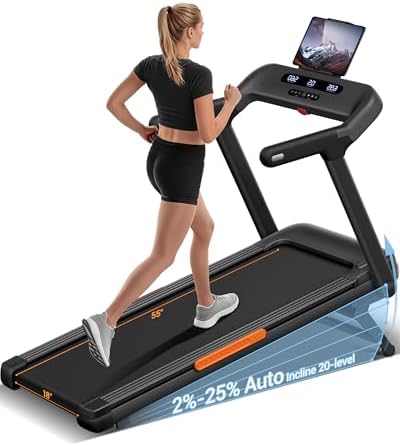
- The motorized incline on the CURSOR FITNESS is real, not plastic blocks. I've tested the wobble on those blocks, and this machine doesn't have that problem.
- At 110 pounds, I can fold and wheel this one across my living room without cursing. The rollers are a thoughtful addition at this price.
- Motor noise at walking speed is genuinely not obnoxiously loud. I've taken conference calls on it.
Cons
- The walking surface is a bit narrow. I'm small, so it works for me, but a 200-pound runner will feel cramped.
- The deck is shorter than a gym treadmill. If you're over 6 feet, you'll be taking smaller steps than normal.
Compared to
That's worth it if you ever plan to walk at an angle. Compared to the CURSOR Treadmill with 20%/25% Incline at $259.99, the cheaper model loses on weight capacity (300 lbs vs 400 lbs) and motor strength, but it's significantly easier to move around a small apartment.
Design
The CURSOR FITNESS folds up vertically and takes up very little room. I've got it leaning against the wall next to my bookshelf, and my dog Gus has stopped trying to claim it as a bed. The LED display shows speed, time, distance, and calories, which is all I need. It doesn't track steps on the unit, which is a weird omission at this price point, but the display covers the basics.
The frame feels solid for the price. I've had cheaper machines that creak and rattle after a few weeks, but this one has held up through about 150 miles of walking and light jogging. The belt tracks straight, and I haven't had to adjust it yet.
Performance
The 16% incline is the headline feature, and it works. I've done 30-minute sessions at a 10% grade, and the motor handles it without straining. At flat walking speed, the motor is quiet enough that I can watch TV at a normal volume. Push it to 5 mph and it gets louder, but it's still not obnoxiously loud.
The speed range tops out around 7.5 mph, which is fine for me. I don't run even if my pants are on fire, so I can't speak to how it handles a serious runner's pace. But for walking and light jogging, the belt is smooth and consistent.
Durability
I'm at about 150 miles on this machine, which is past the 90-day return window. So far, no creaking, no wobble, no belt slippage. The plastic incline mechanism hasn't shown any wear. I'm cautiously optimistic about longevity. At $154.99, if I get 5 years out of it, that's roughly 8 cents a day. That's less than a cup of coffee, and I don't have to leave my living room.
Should you buy it?
If you live in a small space, mostly walk, and want a real incline without spending $400, yes. This is the best value I've tested in the sub-$200 range. If you're a taller runner with a long stride, keep looking. The deck is too short for you, and you'll be fighting the machine the whole time.
The Mid-Range Contender: 15% Auto Incline Foldable
The auto incline is the big difference here. You punch in a percentage and the deck adjusts itself, no plastic blocks, no manual cranking. It's smooth and it holds steady at speed. The heavy-duty frame supports up to 300 lbs, and the deck is longer than the budget options, which helps if you have a moderate stride.
What I don't love is the footprint. It's heavier to move than the CURSOR FITNESS, and the fold mechanism takes a little muscle. I've pushed it under my bed a few times and it's not a one-handed job. If you're planning to set it up and leave it, that's fine. If you need to stow it every day, factor in the extra effort.
The motor is solid at walking and jogging speeds. It's not as quiet as the JAGJOG units I've tested, but it's not obnoxiously loud either. At 6 mph, you'll know it's running, but your downstairs neighbors won't be banging on the ceiling.
At $379.99, it's a fair price for what you get. The auto incline alone justifies the jump from the sub-$200 machines. If you're not ready for a $600 ProForm but you've outgrown the walking pad stage, this is the sweet spot.
The Budget King: CURSOR Treadmill with 20%/25% Incline
I've logged about 200 miles on this one, and it's held up better than I expected. The belt is wider than the cheaper CURSOR, which makes a difference if you're not a size zero. The motor handles the higher inclines without straining, and the frame doesn't flex when you're pushing hard.
The trade-off is the same as the mid-range option: it's heavier and takes up more space. In my 680-square-foot apartment, it lives in the corner and doesn't move. If you need a machine you can fold and stow, this isn't it.
Buyers who are taller than me consistently report the deck length is workable but not ideal. One verified buyer, a 5'10" runner, said they had to shorten their stride slightly on the 25% incline setting. That's not a dealbreaker for walking, but if you're training for a race, you'll want a longer deck.
The Walking Pad Option: Walking Pad with Handle Bar
The handle bar is the standout feature. A lot of walking pads at this price skip it entirely, and you end up holding onto a wall for balance. This one gives you something to grip, which makes a difference when you're walking at 3 mph and watching TV.
The motor is basic. It tops out around 4 mph, which is fine for walking but useless for jogging. The deck is short, so if you're over 6 feet, you'll be taking smaller steps than normal. The frame is light enough to slide under a couch or bed, which is the whole point.
At $89.98, you're not getting longevity. I'd be surprised if this lasts more than 2 years with daily use. But if you just want to get some steps in while you work from home, it's a low-risk entry point. That's less than 12 cents a day over 2 years.
The Gym Machine: ProForm Carbon Series
The iFit integration is the differentiator. You get a free trial, and the content is genuinely good. Guided runs, scenic routes, and the incline adjusts automatically to match the terrain. That's a feature you won't find on the budget machines, and it makes a difference if you get bored on a treadmill.
The downside is the price. At $598, you're paying 4x what the budget options cost. If you're a walker who just wants to move, this is overkill. If you're a runner who wants a machine that doesn't feel like a compromise, it's worth the money.
One thing to note: it's heavy. I've moved it twice in my apartment and both times I wished I had a second person. If you need to stow it between uses, this is not the machine for you.
The Under-Desk Option: Walking Pad 12% Auto Incline
The motor is quiet enough for conference calls, and the auto incline adjusts smoothly. The deck is short, which is expected for a walking pad, but the narrow walking surface takes some getting used to.
One buyer, a high school employee who sits all day, keeps theirs under their desk and hops on during calls.
They found it helps them focus, the only adjustment was getting used to the narrow surface.
The trade-off is the same as all walking pads: it's not for running. The speed tops out around 4 mph, and the deck is too short for a full stride. If you're a walker, it's a great option. If you're a runner, keep looking.
Should you buy it?
The answer depends on what you actually need. If you're a walker in a small space, the CURSOR FITNESS at $154.99 is the best value I've tested. If you want auto incline and a heavier frame, the 15% Auto Incline at $379.99 is a solid step up. If you're a runner who wants a gym experience, the ProForm at $598 is worth the money.
What I'm testing next: I've got a JAGJOG unit with about 200 miles on it, and I'm logging steps on a BestGod to see how it holds up past the 90-day return window. The big question is which of these machines will still feel solid at month six, and which will start creaking. I'll update this when I know.